-->
Showing posts with label Human Interest. Show all posts

Thursday, September 15, 2016

Interviewing Buddhist Women: Jacqueline Kramer, Part 2

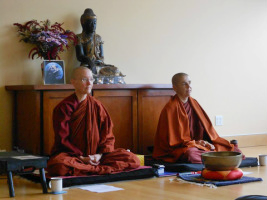
Jacqueline Kramer with Susan Pembroke, founder of  the Alliance for Bhikkhunis
and Insight Meditation Ventura

In this two part series, Ven. Adhimutta interviews Jacqueline Kramer, author of Buddha Mom and 10 Spiritual Practices for Busy Parents. To read Part 1 please click here.

Ven. Adhimutta: How did you become involved with Sakyadhita International (SI) and what are your her opinions on women in Buddhism?

Monday, March 7, 2016

Curiosity and Doubt: The Spiritual Career of Judith Simmer-Brown

By Caitlin Dwyer
 
Teaching on the Dakini in Tibetan Buddhism at Sivananda Ashram Yoga Retreat.
Watch teaching on YouTube.

Small-town Nebraska is about as far from India as a person can get, but for Buddhist scholar and acharya Judith Simmer-Brown, who grew up there, that faraway place always had a particular draw. Located in the Midwest of the United States, Nebraska has wide swaths of flat farmland sliced by paths for pickup trucks, wind plucking through the fields of corn.

“As a child, I had tremendous religious and spiritual curiosity,” recalls Simmer-Brown, the daughter of a Methodist minister. “I asked a lot of people, I read biographies . . . I started a methodical prayer practice. I feel like I had some kind of past-life affinity for meditation.”

That curiosity has carried Simmer-Brown through a lifetime of religious study—leading her to India, where she was first exposed to meditation, to an early devotion to Zen, to a doctorate in Buddhism, and eventually, to a position as an acharya, or senior Dharma teacher, in the Shambhala lineage of Chögyam Trungpa Rinpoche and to a teaching role at Naropa University in Colorado. Curious and questioning, her spiritual intellect has driven her to embody a unique position bridging the divide between the practice of Dharma and the analytical study of religion.

Monday, October 19, 2015

Finding My Way

Jessica Morey

When all of our lives are so similar and yet so different, where can we look for guidance? As Jessica Morey has learned—and what she now teaches to teenagers—the best guidance is discovered in ourselves.

The eighth grade was no picnic. Like a lot of 14-year-olds, I felt isolated and confused. Where to go in life? And the combination of pulling away from my parents and dealing with my peers didn’t help. Were my friends rapping with the same stuff I was? How could I know? I could barely name it for myself.

My mom made a proposal: “You and your brother should try a mindfulness retreat.” If I hadn’t seen over the years how she herself seemed different after her occasional retreats at the Insight Meditation Society (IMS)—when she came home, her eyes seemed filled with what I could only describe as joy—I never would have agreed.

But my brother and I did agree. So we headed off to IMS, full of skepticism and with a promise that if we didn’t like it, mom would come get us.

It was strange when we arrived. Everyone seemed a little too nice. But our fellow teenagers seemed pretty normal, so we both decided to give it a go.

Monday, August 24, 2015

White Robes, Saffron Dreams: A Look at Gender Inequality in Thai Buddhism

Hilary Cadigan 
June 6, 2014
http://www.chiangmaicitynews.com/news.php?id=3984

One of the most distinct illustrations of gender inequality in Thailand is found in its most entrenched institution: religion. In her fascinating new documentary, White Robes, Saffron Dreams, acclaimed filmmaker Teena Amrit Gill explores the discriminatory treatment of women within Thai Buddhism, a topic that has gone largely unexamined in the past.

One of the Buddhist nuns depicted in the film.

The 43-minute documentary, which was released last year and is currently on the festival circuit, follows the story of a Buddhist monk and a Mae Chi (Buddhist nun), and explores the sharp difference in opportunities for males versus females in Thailand, a country that is 95% Buddhist.

Monday, June 15, 2015

What Would I Do for the Dharma? Thinking about Ryonen

Susan Moon

Image 1: Calligraphy
by Ryonen Genso
Ryonen was a woman Zen teacher in 17th century Japan. A story about her has been cooking inside of me ever since I read it some years ago.

As a young woman, Ryonen Genso was an attendant to the empress, and was known for her beauty and intelligence. When the empress died, she felt the impermanence of life, and she went in search of a Zen master with whom she could practice.

She traveled to the monastery of Master Hakuo Dotai, who refused her because of her beauty, saying her womanly appearance would cause problems for the monks in his monastery.

Afterward, she saw some women pressing fabric by a river, and she took up a hot iron and held it against her face, scarring herself. Then she wrote this poem on the back of a small mirror:
To serve my Empress, I burned incense to perfume my exquisite clothes.
Now as a homeless mendicant I burn my face to enter a Zen temple.
The four seasons flow naturally like this.
Who is this now in the midst of these changes?
She returned to Hakuo and gave him the poem. Hakuo immediately accepted her as a disciple. She became abbess of his temple when he died, and later founded her own temple. Before her death she wrote the following poem:
This is the sixty-sixth autumn I have seen.
The moon still lights my face.
Don’t ask me about the meaning of Zen teachings—
Just listen to what the pines and cedars say on a windless night.

Monday, June 8, 2015

On the Front Lines

This essay was drawn from an interview conducted by Dennis Crean, former managing editor of Inquiring Mind (1998-2011) and Martha Kay Nelson, also an editor of the Mind (2011-present).
From Inquiring Mind, Vol. 31, #2 (Spring 2015). © 2015 by Inquiring Mind. Used by permission. 

Paper copies of the final issue of Inquiring Mind are available here only until 15 June 2015.
__

By Ayya Santacitta & Ayya Santussika

We women monastics don’t have the privilege of shutting ourselves off from the need for change. Because we are not part of the establishment, we live our lives on the front lines. As bhikkhunis, what pulls us to the front lines of climate change is the pioneering spirit of the bhikkhuni movement itself. We are already going against the grain to reestablish the order of fully ordained Theravada nuns; we’re willing to step out of a patriarchal system and create something new. And because we lack the “golden handcuffs” of abundant financial support, we don’t have to worry about keeping everybody happy. We have the freedom to respond to the urgent needs of the day, applying the Buddha’s teachings to the crises humanity faces now.

Image 1: Ayya Santussika and Ayya Santacitta 
teaching a daylong retreat on "Stable Heart, Stable 
Climate" at Insight Santa Cruz.
We are working to pass on to the next generation a presentation of the Dhamma that is applicable to this day and age. A contemporary Dhamma has to be embodied by both female and male monastics, otherwise many people will turn away, thinking this religion doesn’t recognize the clear truth that women and men alike are both sorely needed as leaders. The Dhamma must not be confined to the old order of things, which is very much about dominating nature, taking what you can get and throwing back what you don’t want. This is the way women—and the environment—have been treated for centuries. As bhikkhunis, we are stepping out of that.

Monday, June 1, 2015

History of Women in Buddhism - Indonesia: Part 9

Tomé Pires Witness & the Beguines, 

change comes to the roles of women in religion in Indonesia


Ayyā Tathālokā Bhikkhunī

In this ninth post in our “History of Women in Buddhism - Indonesia” series leading up to the Sakyadhita International Buddhist Women’s Conference in Indonesia, we come to the last of the ancient and premodern records of Buddhist women leaders, kilis and bhikkhunīs in Indonesian Buddhism, with one final and telling glimpse from a surprising Western source, before sweeping social changes overtook Java, Sumatra and much of the archipelago. We touch on some of the changes brought by Islam and by Colonialism, and the impact they had on women in Indonesian religion and spirituality, and women in Buddhism.

Extracted from Ayyā Tathālokā’s paper “Light of the Kilis: Our Indonesian Bhikkhuni Ancestors,” this article is part of the series leading up to the 14th Sakyadhita Conference in Yogyakarta, Indonesia. This article is dedicated to the first Theravada bhikkhunī ordination in contemporary times in Indonesia which is planned to precede the Sakyadhita Conference in June 2015. 


Monday, May 25, 2015

History of Women in Buddhism - Indonesia: Part 8

Gāyatrī Rājapatni: Queen, Bhikkhunī & the Prajñāpāramitā


Ayyā Tathālokā Bhikkhunī[1]

In this eighth post in our “History of Women in Buddhism - Indonesia” series leading up to the Sakyadhita International Buddhist Women’s Conference in Yogyakarta, Indonesia, we explore the life of one of Indonesia’s most interesting historical Buddhist women.  Earlier prominent women leaders and women ascetics/monastics/nuns that we’ve portrayed in this series such as Ken Dedes, Bhrikuti, Devi Kilisuci, Ratu Shima and Manimekhalai have been interesting in enigma--they are fascinating in that we catch such brief glimpses of their lives, leaving so much to be filled in by imagination, as we find in the many Indonesian, Indian and Tibetan legends, operas and ballets through which their lives are popularly remembered. In this post however, we have the benefit of a lengthy and highly-descriptive historical documentary poem written by a co-contemporary Buddhist monastic poet/biographer/documenteur passed down to us intact, and at least one very well-preserved mortuary portrait image, the Prajñāpāramitā.  Of further interest in addendum is the role that this image has come to play in the contemporary re-nascence of the Theravada Bhikkhunī Sangha on the other side of the world, in North America.

Extracted from Ayyā Tathālokā’s paper “Light of the Kilis: Our Indonesian Bhikkhuni Ancestors,” this article is part of the series leading up to the 14th Sakyadhita Conference in Yogyakarta, Indonesia.  This post coincides with the release of the first English-language edition of Earl Drake’s Gayatri Rajapatni: The Woman Behind the Glory of Majapahit by Areca Books.


Gāyatrī Rājapatni: Queen, Bhikkhunī & the Prajñāpāramitā


Image 1: Prajñāpāramitā image from East Java
at the National Museum of Indonesia, Jakarta
We will now meet one of the greatest of those women whose life has been passed down to us in memory, posthumously captured by the Buddhist monk poet of the court who knew and wrote of her with such reverence and appreciation.  This woman is the lady Gāyatrī, also known as the Rājapatni, in a way somewhat similar to and reminiscent of the lady Gotamī, also known as the Great Prajāpatī.[2]

Gāyatrī was a devout Buddhist, and the youngest daughter of the founder of Majapahit, the last of the great Indonesian royal dynasties, known as the Rajasa Dynasty.  She had three elder siblings, and together they were known as The Four Princesses of Singasari (Singosari).  The epics remember Gāyatrī as having been a keen student of literature, and political, social and religious matters. She possessed extraordinary beauty, charm, wisdom and intelligence.  And yet, in 1276 CE, at the tender age of sixteen, in a terrible repeat of what happened to Airlangga two hundred years earlier {in Post 5}, her world went mad. She witnessed the destruction of her home and kingdom and the murder of her father under the unsuspected attack of the Duke of Kederi.

Monday, April 27, 2015

History of Women in Buddhism - Indonesia: Part 6

Bhrikutī & the Appearance of New Non-Bhikkhunī Forms of Women’s Asceticism in Buddhism


Ayyā Tathālokā Bhikkhunī

Image 1: Bhrikutī Devī, Nepal
In this sixth post in our “History of Women in Buddhism - Indonesia” series, we pick up a topic that is only hinted at being possible in Part 5 - the subject of the appearance of non-bhikkhunī/bhikṣuṇī forms of women’s (and men’s) ascetic/spiritual ideals (and practices) in Buddhism.  It is a time in history or her-story when both royal blood and ascetic spiritual power and mastery appear to have become an essential qualification of the deification of the fe/male rulers of the land, often united with or balanced by their co-appearance as either awesome likenesses or living embodiments of the bodhisattvas and buddhas of Mantranāya and Tantrayāna Buddhism, which has been spreading and developing in Java now for a period of more than 500 years (from the 7th-13th century). We look at one such example in the image of Bhrikutī, an apparently royal female ascetic of spiritual power, who appears very close to the most exemplary Śaivite royal female ascetic and consort, Parvatī, and yet is a manifestation of both the Buddhist wisdom of the bodhisattva Avalokiteśvara, and the fierce form of compassion of the savioress, Bhagavātī Aryā Tārā.
This post is specially dedicated to all those affected by the 25 April 2015 earthquakes in Nepal and the surrounding areas, to all those in need, and to all those who are helping. 
Extracted from Ayyā Tathālokā’s paper “Light of the Kilis: Our Indonesian Bhikkhunī Ancestors,” this is the sixth part in our “Women in Buddhism - Indonesia” mini-series leading up to the 14th Sakyadhita Conference in Borobudur, Indonesia.

Monday, August 18, 2014

In Scarred Chinese Tibetan City, Devotion to Sanctity of Life

Andrew Jacobs,
New York Times


A Tibetan woman in Yushu, China, used a spoon and plastic bucket to rescue tiny shrimp stuck in mud along the shore of the Batang River. Credit Gilles Sabrie, New York Times

YUSHU, China — With a set of chopsticks in her hands and a Tibetan prayer spilling from her lips, Gelazomo, a 32-year-old yak herder, hunched over the rocky banks of the river that cuts through this city and hunted for the quarry that she hoped would bring salvation.

Every few minutes, she would tease out a tiny river shrimp that had become stranded in the mud, and then dropping it into a bucket of water. Beside her, dozens of other Tibetans toiled in the noonday sun, among them small children and old people who, from afar, appeared to be panning for gold.

“Buddha has taught us that treating others with love and compassion is the right thing to do, no matter how tiny that life is,” she explained, as the newly revived crustaceans darted through the water of her bucket.

Buddhists are encouraged to demonstrate a reverence for all sentient beings; some believers spurn meat while others buy animals destined for slaughter and then set them free. Here in Yushu, a largely Tibetan city where more than 3,000 people died in an earthquake four years ago, the faithful have been flocking to the Batang River to rescue a minuscule aquatic crustacean that would hardly seem deserving of such attention.

Read More