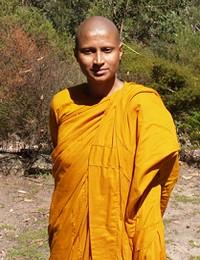
Extract from a Dhamma talk by Ajahn Sundara
 Our emotions can be triggered by something very small: a physical sensation, a passing thought, a sense contact, a feeling. In the context of Dhamma we begin to notice that in fact emotions are constructs: amalgams of thought, feeling, perceptions, past conditioning, trauma, family stories; all these things come together to generate emotions. Sometimes we are in a situation where for no apparent reason we start crying, or we become angry or confused. When we search for a reason but can’t find one, we may think there is something wrong with us, that it’s our fault. We make ourselves miserable because we don’t understand that there is a bigger picture. Being human is like that.
Modern psychology has not been able to define emotion. Decades of brain research have failed to pin down what an emotion is. It fluctuates constantly; it is indefinable. So we may be sitting calmly in meditation, surrounded by a lot of other people, but when somebody else comes into the room our sense of calm changes. We are aware of a new feeling tone, perhaps an emotional charge in the body and we soon realize that letting go of it requires more than just awareness and willingness to let go. It also calls for wisdom, for understanding, so as to see deeply its true characteristics of anicca-dukkha-anattā – that it is impermanent, unsatisfactory, and not-self.
Modern psychology has not been able to define emotion. Decades of brain research have failed to pin down what an emotion is. It fluctuates constantly; it is indefinable. So we may be sitting calmly in meditation, surrounded by a lot of other people, but when somebody else comes into the room our sense of calm changes. We are aware of a new feeling tone, perhaps an emotional charge in the body and we soon realize that letting go of it requires more than just awareness and willingness to let go. It also calls for wisdom, for understanding, so as to see deeply its true characteristics of anicca-dukkha-anattā – that it is impermanent, unsatisfactory, and not-self.