Showing posts with label Gender in Buddhism. Show all posts

Monday, August 15, 2016

Interviewing Buddhist Women: Jacqueline Kramer, Part 1

Photo Courtesy of Luboš Račanský, "Love." Creative Commons.
In this two part series, Ven. Adhimutta interviews Jacqueline Kramer, author of Buddha Mom and 10 Spiritual Practices for Busy Parents. Stay tuned for Part 2 in September.

Ven. Adhimutta: What led you to be interested in Buddhism? 

Jacqueline Kramer: I was led to Buddhism at a very young age. I had the good fortune to have a mother who was a mystic and spiritual seeker. She was meditating and practicing yoga in the late 1950’s. My birth religion is Judaism and my mother taught Sunday school at our local temple. They didn’t have her continue teaching because she was too ecumenical for them. She imparted this openness to all wisdom paths to me. When I was around 11 years old, she asked me if I wanted to commit to Judaism and become batmitzvahed. I told her there were certain things Judaism taught that I couldn’t go along with. She said, that was fine, but I had to continue my religious training somewhere. I chose a Vedanta temple I had visited in Hollywood. This is the wonder of my mother - she drove me to that temple to hear the sermons every weekend. Then in junior high, I got hold of the Paul Reps book, Zen Flesh, Zen Bones, and carried it around in my purse. I loved its direct, clear expression and have since returned to the koan practice it introduced to me.

Monday, March 7, 2016

Curiosity and Doubt: The Spiritual Career of Judith Simmer-Brown

By Caitlin Dwyer
 
Teaching on the Dakini in Tibetan Buddhism at Sivananda Ashram Yoga Retreat.
Watch teaching on YouTube.

Small-town Nebraska is about as far from India as a person can get, but for Buddhist scholar and acharya Judith Simmer-Brown, who grew up there, that faraway place always had a particular draw. Located in the Midwest of the United States, Nebraska has wide swaths of flat farmland sliced by paths for pickup trucks, wind plucking through the fields of corn.

“As a child, I had tremendous religious and spiritual curiosity,” recalls Simmer-Brown, the daughter of a Methodist minister. “I asked a lot of people, I read biographies . . . I started a methodical prayer practice. I feel like I had some kind of past-life affinity for meditation.”

That curiosity has carried Simmer-Brown through a lifetime of religious study—leading her to India, where she was first exposed to meditation, to an early devotion to Zen, to a doctorate in Buddhism, and eventually, to a position as an acharya, or senior Dharma teacher, in the Shambhala lineage of Chögyam Trungpa Rinpoche and to a teaching role at Naropa University in Colorado. Curious and questioning, her spiritual intellect has driven her to embody a unique position bridging the divide between the practice of Dharma and the analytical study of religion.

Tuesday, February 2, 2016

Gyalwang Karmapa Teaches on Bodhichitta &
Discusses Bhikshuni Ordination Plans

His Holiness the Gyalwang Karmapa during the Third Arya Kshema Winter Dharma Gathering.

January 15, 2016 -Tergar Monastery, Bodh Gaya, Bihar India 

During the second day of the Third Arya Kshema Winter Dharma Gathering, the Gyalwang Karmapa continued his teaching on Gampopa’s Ornament of Precious Liberation, describing the causes for arousing bodhichitta. He also discussed the issue of the nun’s ordination, indicating that although he had hoped to initiate the process of giving Bhikshuni ordination this year, it had to be postponed for a variety of reasons.

The teaching today was focused on the four causes of arousing bodhichitta presented in the Levels of the Bodhisattva by Asanga. The first cause of arousing bodhichitta is seeing or hearing of the powers of the Buddhas and Bodhisattvas. The Karmapa explained that for this reason, studying the life stories of Buddhas and Bodhisattvas of the past is important.

Monday, December 28, 2015

Earning a Degree: Tibetan Nuns Break Through Barriers

Rio Helmi

Délek Dölma left her home in Kham in Tibet's eastern regions at the age of 20. Ordained but illiterate, she yearned to study Buddhism in a more profound way. Délek Wangmo was 16, also ordained, could barely read but was equally determined to deepen her knowledge and understanding of Buddhism. In traditional Tibetan society, when it comes to opportunity to study, nuns are at the bottom end of the priority list. Painfully aware of the fact that in Tibet they hardly stood a chance of studying, much less achieving a scholastic degree, they resolved to escape to India to pursue their dream within the Tibetan community in exile.

They also resolved to generate the "merit" -- which in Buddhist terms refers to the expansive power of the mind generated by virtuous acts -- for this bold undertaking in a uniquely Tibetan way. They journeyed from Lithang to Lhasa by doing full-length prostrations the whole way. To get an idea of what that entails: with your mind focused on the Buddha first you do a full-length prostration flat on the ground, with arms out, then stand up, and then move to the mark where the tips of your fingers touched the ground. And then you start again. Repeat for as many times as it takes to cover 1,475 kilometers. It took them a year and a half.

A philosophy class at Dolma Ling nunnery, via Rio Helmi
It would seem the merit they generated helped: once in India they were soon taken under the wing of the Tibetan Nun's Project created by the Tibetan Women's Association to provide education for nuns. By 1993 they were both were inscribed in a long-term study program, the first of its kind. In 2005 the Dolma Ling nunnery, spearheaded by His Holiness the Dalai Lama's sister-in-law Rinchen Khando, opened its doors. To date over 200 nuns have joined the two in this nunnery.

Monday, June 29, 2015

History of Women in Buddhism - Indonesia: Part 10

Shedding Light on the Bhikkhunīs & the Great Founding Women of Borobudur

Ayyā Tathālokā Bhikkhunī


the Bhikkhunīs of Borobudur
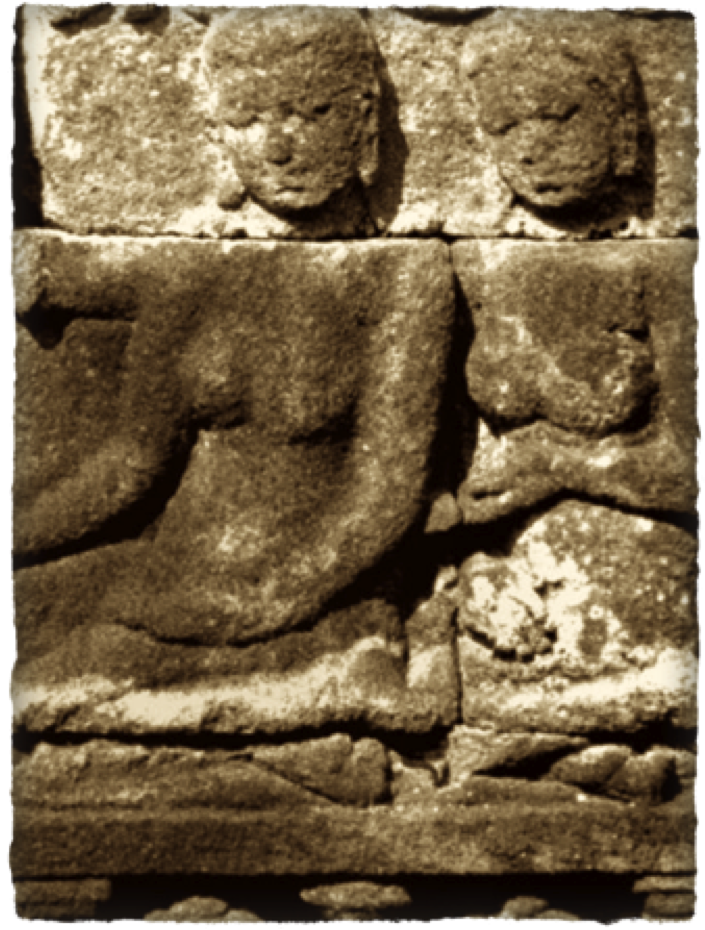
Image 1: Bhikkhunīs of Borobudur
This paper is the tenth and final post in a series of extracts from the larger article titled “Light of the Kilis: Our Indonesian Bhikkhunī Ancestors” which explores what is known of the ancient Buddhist women monastics and ascetics of the Indonesian archipelago.
 
Chronologically, this post falls between part 4 and part 5 in this Awakening Buddhist Women blog series. Prepared especially for the 14th Sakyadhita International Conference in Yogyakarta, this previously unpublished extract was presented live at the Sakyadhita Conference. 

“Light of the Kilis” is based on research materials gathered from travelogues, local oral traditions, dedicatory inscriptions, monuments, and statuary, or what remains of these within their cultural and historical context. The materials span a time period of more than 2000 years, from the 3rd century BCE up to modern times.

Here we focus on the 8th and 9th centuries and materials that are of direct relevance to the Sakyadhita Conference locale and of special interest and value to women in Buddhism. I touch on the feminine aspect of Indonesian candis, the appearance and role of both the esoteric Bhagavatī Aryā Tārā, the human queen Devī Tārā, and her daughter (or granddaughter) Śrī Sanjiwana Prāmodhavardhanī, the latter two Buddhist women being key persons involved with the foundation and establishment of the world-famous Borobudur monument. I also highlight images of bhikṣuṇīs and the dual sangha (bhikkhus and bhikkhunīs) that are portrayed on three levels of the wall reliefs of the Borobudur monument. These images are of outstanding historical value, because we can glean from them unparalleled visual knowledge of Buddhist women’s monastic way of life at the time they were created. I review and describe these images in the context of the Dharma teaching stories they illustrate – shining examples of women’s leadership and eminence in the Buddhist sangha, as they were conceived of and understood during this period.

Monday, June 15, 2015

What Would I Do for the Dharma? Thinking about Ryonen

Susan Moon

Image 1: Calligraphy
by Ryonen Genso
Ryonen was a woman Zen teacher in 17th century Japan. A story about her has been cooking inside of me ever since I read it some years ago.

As a young woman, Ryonen Genso was an attendant to the empress, and was known for her beauty and intelligence. When the empress died, she felt the impermanence of life, and she went in search of a Zen master with whom she could practice.

She traveled to the monastery of Master Hakuo Dotai, who refused her because of her beauty, saying her womanly appearance would cause problems for the monks in his monastery.

Afterward, she saw some women pressing fabric by a river, and she took up a hot iron and held it against her face, scarring herself. Then she wrote this poem on the back of a small mirror:
To serve my Empress, I burned incense to perfume my exquisite clothes.
Now as a homeless mendicant I burn my face to enter a Zen temple.
The four seasons flow naturally like this.
Who is this now in the midst of these changes?
She returned to Hakuo and gave him the poem. Hakuo immediately accepted her as a disciple. She became abbess of his temple when he died, and later founded her own temple. Before her death she wrote the following poem:
This is the sixty-sixth autumn I have seen.
The moon still lights my face.
Don’t ask me about the meaning of Zen teachings—
Just listen to what the pines and cedars say on a windless night.

Monday, June 1, 2015

History of Women in Buddhism - Indonesia: Part 9

Tomé Pires Witness & the Beguines, 

change comes to the roles of women in religion in Indonesia


Ayyā Tathālokā Bhikkhunī

In this ninth post in our “History of Women in Buddhism - Indonesia” series leading up to the Sakyadhita International Buddhist Women’s Conference in Indonesia, we come to the last of the ancient and premodern records of Buddhist women leaders, kilis and bhikkhunīs in Indonesian Buddhism, with one final and telling glimpse from a surprising Western source, before sweeping social changes overtook Java, Sumatra and much of the archipelago. We touch on some of the changes brought by Islam and by Colonialism, and the impact they had on women in Indonesian religion and spirituality, and women in Buddhism.

Extracted from Ayyā Tathālokā’s paper “Light of the Kilis: Our Indonesian Bhikkhuni Ancestors,” this article is part of the series leading up to the 14th Sakyadhita Conference in Yogyakarta, Indonesia. This article is dedicated to the first Theravada bhikkhunī ordination in contemporary times in Indonesia which is planned to precede the Sakyadhita Conference in June 2015. 


Monday, May 25, 2015

History of Women in Buddhism - Indonesia: Part 8

Gāyatrī Rājapatni: Queen, Bhikkhunī & the Prajñāpāramitā


Ayyā Tathālokā Bhikkhunī[1]

In this eighth post in our “History of Women in Buddhism - Indonesia” series leading up to the Sakyadhita International Buddhist Women’s Conference in Yogyakarta, Indonesia, we explore the life of one of Indonesia’s most interesting historical Buddhist women.  Earlier prominent women leaders and women ascetics/monastics/nuns that we’ve portrayed in this series such as Ken Dedes, Bhrikuti, Devi Kilisuci, Ratu Shima and Manimekhalai have been interesting in enigma--they are fascinating in that we catch such brief glimpses of their lives, leaving so much to be filled in by imagination, as we find in the many Indonesian, Indian and Tibetan legends, operas and ballets through which their lives are popularly remembered. In this post however, we have the benefit of a lengthy and highly-descriptive historical documentary poem written by a co-contemporary Buddhist monastic poet/biographer/documenteur passed down to us intact, and at least one very well-preserved mortuary portrait image, the Prajñāpāramitā.  Of further interest in addendum is the role that this image has come to play in the contemporary re-nascence of the Theravada Bhikkhunī Sangha on the other side of the world, in North America.

Extracted from Ayyā Tathālokā’s paper “Light of the Kilis: Our Indonesian Bhikkhuni Ancestors,” this article is part of the series leading up to the 14th Sakyadhita Conference in Yogyakarta, Indonesia.  This post coincides with the release of the first English-language edition of Earl Drake’s Gayatri Rajapatni: The Woman Behind the Glory of Majapahit by Areca Books.


Gāyatrī Rājapatni: Queen, Bhikkhunī & the Prajñāpāramitā


Image 1: Prajñāpāramitā image from East Java
at the National Museum of Indonesia, Jakarta
We will now meet one of the greatest of those women whose life has been passed down to us in memory, posthumously captured by the Buddhist monk poet of the court who knew and wrote of her with such reverence and appreciation.  This woman is the lady Gāyatrī, also known as the Rājapatni, in a way somewhat similar to and reminiscent of the lady Gotamī, also known as the Great Prajāpatī.[2]

Gāyatrī was a devout Buddhist, and the youngest daughter of the founder of Majapahit, the last of the great Indonesian royal dynasties, known as the Rajasa Dynasty.  She had three elder siblings, and together they were known as The Four Princesses of Singasari (Singosari).  The epics remember Gāyatrī as having been a keen student of literature, and political, social and religious matters. She possessed extraordinary beauty, charm, wisdom and intelligence.  And yet, in 1276 CE, at the tender age of sixteen, in a terrible repeat of what happened to Airlangga two hundred years earlier {in Post 5}, her world went mad. She witnessed the destruction of her home and kingdom and the murder of her father under the unsuspected attack of the Duke of Kederi.

Monday, May 11, 2015

“We must get back to the real roots of our Buddhist culture”

An interview with Ven. Bodhicitta by Raymond Lam

Ven. Bodhicitta
In March, Buddhistdoor International published an editorial about the era of simultaneous crisis and opportunity for the Theravada sangha across the traditional Buddhist world. The problems for the sangha, while always influenced by politics, social forces, and shifting economic dynamics, are largely internal: nationalism, sexism (and in some cases institutional gynophobia) and a lack of education form a triple-pronged threat to the Theravada sangha’s moral authority (and for some critics, outright relevance). Yet the other face of crisis is opportunity:  In both Asia and the West, watchers and commentators of Buddhism’s story in the globalizing world are noticing several hotspots where events may well reverberate across Asia and influence social justice movements positively.

Take, for example, the recent establishment of a Buddhist college for nuns in Sri Lanka. Regardless of the politics (and monks are always political in Sri Lanka), it is difficult to disagree that this is a millennial milestone for the country’s Buddhist community, and it is one example of turning the crisis of women’s lack of opportunity to practice into a chance to strengthen and reform the sangha – something that all Buddhists surely agree is a good thing.

One of the nuns bearing witness to these changes is Ven. Bodhicitta, founder of the Nisala Arana in Molkawa. Like many pro-bhikkhuni teachers across the world, Ven. Bodhicitta believes that traditional Buddhist values were never patriarchal, androcentric, misogynistic or sexist to begin with. She therefore does not accept the a priori fusion of the Buddhist story with the male experience, and like many feminists, seeks to entangle social conditioning from reality. “Most traditional societies have been conservative, but I don’t think this is the issue. The problem in places like Thailand is more to do with an overarching patriarchy,” she says. “Men are seen as leaders and promoted to positions of authority in patriarchal society, whereas women always have to take a second place, a subordinated place, in society.”

Monday, May 4, 2015

History of Women in Buddhism - Indonesia: Part 7

Ardhanārīśvarī Ken Dedes & Gender in Ancient Indonesian Buddhism


Ayyā Tathālokā Bhikkhunī

In this seventh post in our “History of Women in Buddhism - Indonesia” series, we continue to look at a topic about which questions have been raised in Part 6 - the subject of the compassionate manifestations of gender in Buddhism and its harmonious associations with Hinduism, in ancient Indonesian Buddhism. For, in Part 6, we encountered the Amoghapaśa form of the highly popular bodhisattva mahāsattva Avalokiteśvara (अवलोकितेश्वर), commonly known as Kwan Yin, 觀音, 觀世音 or 觀自在 菩薩摩诃萨埵 in Chinese, or Chenrezig, སྤྱན་རས་གཟིགས་ in Tibetan. This bodhisattva is well known not only in Mahāyāna Buddhism, but amidst the Theravāda Buddhists of Southeast Asia as well.

Originally, in India, Avalokiteśvara Bodhisattva is known for having appeared in male form, as also in Indonesia, Tibet, Sri Lanka and Korea, but then for later having appeared in female form as Kwan Yin in China, to many contemporary observers’ wonder and curiosity. How and why did s/he do so? And, was this orthodox and legit? I’ve been asked these questions more than a few times... 

In our last post, we saw how, in India, in the Amoghapāśa Sādhana meditation text authored by 12th century Kashmiri monk Sakyaśrībhadra and in the highly popular earlier Hevajra Tantra, Avalokiteśvara appeared with both male and female emanations, the two primary female emanations being Green Tārā who represented the manifestation of karuṇā—the compassion, and Bhrikuti who manifested the prajñā—the wisdom of the bodhisattva. Thus, when His Holiness the Dalai Lama--himself widely thought to be an incarnation of the bodhisattva Avalokiteśvara--speaks about appearing in female incarnation, or when the Gyalwang Karmapa says it would be no problem in Dharma for the Karmapa to appear as a woman, they may not actually be saying anything strange or unorthodox at all.  Actually, the very high level of bodhisattva that Avalokiteśvara is, is taught to be basically androgynous, and to be able to appear in any form, as needed--and to have no trouble at all with appearing in either male or female form.

Monday, February 16, 2015

Bhikkhuni Nirodha on Ordaining and Renunciation: A Nun’s Journey

Interview by Eng Chin Ho
Buddhist Fellowship of Singapore


Question: Venerable Nirodha, please tell us about your background and what led you to take the Buddhist path?
I was born in Austria in 1945 and arrived in Australia age twenty. I married and divorced, and had no children. I enjoyed lots of travel, a relatively good life, but there slowly arose an increased awareness of no end of wanting and getting.

On a health retreat sometime in the late 1970s, feeling bored, trying to decide whether to play tennis or a card game of bridge, a sudden deep moment of stillness arose, a sense of giving up the endless choices and mental activity. From within that depth a clear question arose in my mind: Do I want to continue with this shallow, easy way of life, or do I want to look for the truth? Without hesitation there came the strong desperate answer and determination that I must look for the truth; even more, I wanted to become the truth.