-->
Showing posts with label Bhikkhunis. Show all posts

Monday, July 4, 2016

Announcement: Sakyadhita E-Book Now Available


The Compassion and Social Justice E-Book is now available online as both a PDF and a Bookmarked PDF. Please visit our Sakyadhita Publications Page to view our E-Publications, as well as available print publications and conference materials.

Additionally, Buddhist Women in A Global Multicultural Community is also available as an e-book.

Friday, May 20, 2016

On Vesak: Venerable Patacara

Author Anonymous

Vesak Day honors the birth, Enlightenment, and death of the Buddha.

It is very useful to regularly reflect on how the things we do affect our minds. When you have done something well, how do you feel about it? There is a feeling of satisfaction and happiness. In turn, this feeling of happiness supports your daily practice, as well as a cause for a successful meditation practice. When we know what habits support the generation of good states of mind we are inclined to develop those habits.

Again and again, looking at the mind, we can see that the actions, tendencies, and habits are very important. The actions and habits we cultivate in the mind are all important factors contributing to the success of our meditation.

Illustration from thebitterstickgirl.sg
Today being the day we commemorate the birth of the Buddha (Vesak), I want to recount a story that will remind us of the qualities that the Buddha possessed. 

This is the story of Patacara, a very important female disciple of the Buddha. In fact, she became the chief disciple of the Buddha with the role of taking care of the training of the monastic rules (vinaya) for female disciples, i.e. the bhikkhuni sangha. According to the story, once she realised all that had to be realised, she became the vinaya expert. Over time Patacara had a huge following of female disciples and students, all of whom also bore the name of Patacara.

Tuesday, February 2, 2016

Gyalwang Karmapa Teaches on Bodhichitta &
Discusses Bhikshuni Ordination Plans

His Holiness the Gyalwang Karmapa during the Third Arya Kshema Winter Dharma Gathering.

January 15, 2016 -Tergar Monastery, Bodh Gaya, Bihar India 

During the second day of the Third Arya Kshema Winter Dharma Gathering, the Gyalwang Karmapa continued his teaching on Gampopa’s Ornament of Precious Liberation, describing the causes for arousing bodhichitta. He also discussed the issue of the nun’s ordination, indicating that although he had hoped to initiate the process of giving Bhikshuni ordination this year, it had to be postponed for a variety of reasons.

The teaching today was focused on the four causes of arousing bodhichitta presented in the Levels of the Bodhisattva by Asanga. The first cause of arousing bodhichitta is seeing or hearing of the powers of the Buddhas and Bodhisattvas. The Karmapa explained that for this reason, studying the life stories of Buddhas and Bodhisattvas of the past is important.

Monday, November 2, 2015

The First Bhikkhuni Ordination at Koh Yo, Thailand

By Venerable Varadhamma Bhikkhu

On Saturday, November 29, 2014 there was a higher ordination for bhikkhunis for the first time at Koh Yo in Songkhla Province, as well as the going forth of another 47 samaneris. Conducting ordinations for females to go forth as samaneris is one of the periodic Dhamma activities at “Tipaya Sathan Dhamma Bhikkhuni Arama.”

This, however, is not the first Bhikkhuni Ordination in Thailand. The first Bhikkhuni Ordination in Thailand took place in about 1928 when the two daughters of Mr. Narin Bhasit took samaneri ordination. His two daughters Jongdee and Sara were 13 and 18 years old respectively at the time of their going forth. After a period of two years, once Sara was fully 20 years old, she took higher ordination as a bhikkhuni. This happened 82 years ago. Nor was the ordination at Koh Yoh the second bhikkhuni ordination in Thailand. In recent times there have been a number of bhikkhuni ordinations held in Thailand, however they were not publicized.

This higher ordination can be considered to be the first ‘formal’ bhikkhuni ordination. Provincial officials were invited to take part in the event so that they could be aware of what was going on in the area under their responsibility. These included the officials from the Buddhist Office of Songkhla, the Provincial Governor of Songkhla, members of the Office for the Management of the Provinces on the Southern Border, represented by Suphanat Sirantavineti, and the Vice Governor of Naratiwat Province, who came to open the event. A letter was sent to inform the Prime Minister of Thailand of the event, which received a letter of thanks in return. Furthermore, a letter was sent to Phra Thep, the Crown Princess of Thailand to ask for her blessing in this event. We, likewise, received a letter from the Royal Office. Therefore, this was not a ‘secret’ ordination, but rather it was formal and openly publicized.

Monday, July 13, 2015

Impressions from the 2015 Sakyadhita International Conference

They came in robes and in street clothes, with perfectly coiffed hair and with shaved heads, in sandals, in boots, and in high heels. They came from all over the world, on wings, on wheels, by foot. They came, the Buddhists, the Muslims, the Hindus, and the Christians, and some who have set aside all religion. They came, over 1,000 of them, in search of inspiration. And that is what they found.


The 2015 Sakyadhita Conference is the first I have attended, though it has been offered for nearly 30 years now. Organized by an ordained woman who practices Tibetan Buddhism and teaches at the University of California in San Diego, the Venerable Karma Lekshe Tsomo, this conference for Buddhist women was centered on the theme of compassion and social justice. It is supported by Venerable Lekshe, other nuns and monks, and dozens of women and men volunteers who gain nothing but the satisfaction of knowing that they have helped so many.

Monday, June 29, 2015

History of Women in Buddhism - Indonesia: Part 10

Shedding Light on the Bhikkhunīs & the Great Founding Women of Borobudur

Ayyā Tathālokā Bhikkhunī


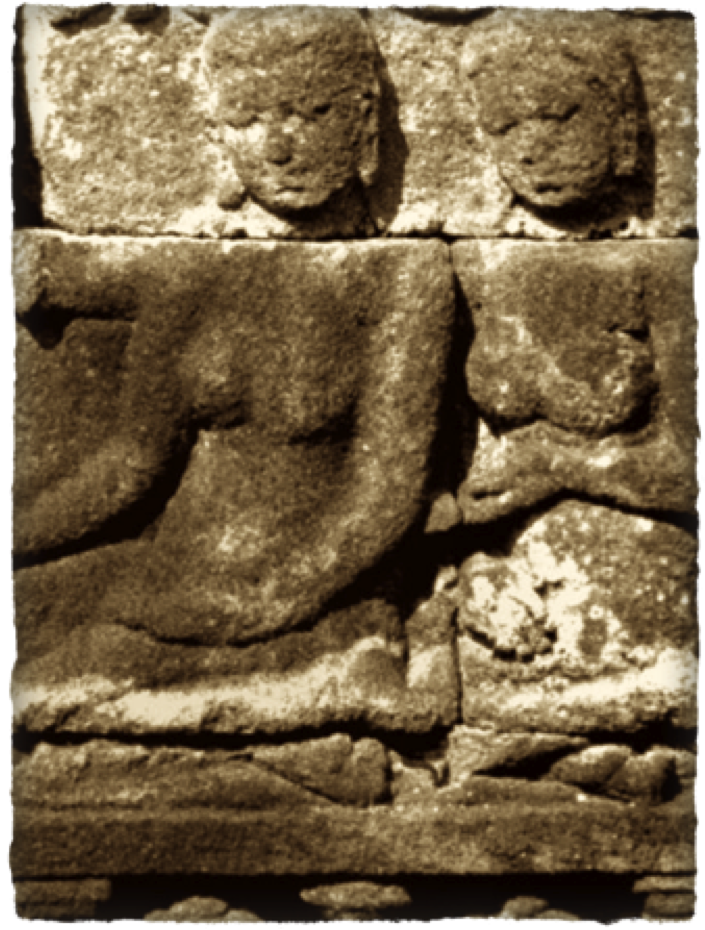
the Bhikkhunīs of Borobudur
Image 1: Bhikkhunīs of Borobudur
This paper is the tenth and final post in a series of extracts from the larger article titled “Light of the Kilis: Our Indonesian Bhikkhunī Ancestors” which explores what is known of the ancient Buddhist women monastics and ascetics of the Indonesian archipelago.
 
Chronologically, this post falls between part 4 and part 5 in this Awakening Buddhist Women blog series. Prepared especially for the 14th Sakyadhita International Conference in Yogyakarta, this previously unpublished extract was presented live at the Sakyadhita Conference. 

“Light of the Kilis” is based on research materials gathered from travelogues, local oral traditions, dedicatory inscriptions, monuments, and statuary, or what remains of these within their cultural and historical context. The materials span a time period of more than 2000 years, from the 3rd century BCE up to modern times.

Here we focus on the 8th and 9th centuries and materials that are of direct relevance to the Sakyadhita Conference locale and of special interest and value to women in Buddhism. I touch on the feminine aspect of Indonesian candis, the appearance and role of both the esoteric Bhagavatī Aryā Tārā, the human queen Devī Tārā, and her daughter (or granddaughter) Śrī Sanjiwana Prāmodhavardhanī, the latter two Buddhist women being key persons involved with the foundation and establishment of the world-famous Borobudur monument. I also highlight images of bhikṣuṇīs and the dual sangha (bhikkhus and bhikkhunīs) that are portrayed on three levels of the wall reliefs of the Borobudur monument. These images are of outstanding historical value, because we can glean from them unparalleled visual knowledge of Buddhist women’s monastic way of life at the time they were created. I review and describe these images in the context of the Dharma teaching stories they illustrate – shining examples of women’s leadership and eminence in the Buddhist sangha, as they were conceived of and understood during this period.

Monday, June 8, 2015

On the Front Lines

This essay was drawn from an interview conducted by Dennis Crean, former managing editor of Inquiring Mind (1998-2011) and Martha Kay Nelson, also an editor of the Mind (2011-present).
From Inquiring Mind, Vol. 31, #2 (Spring 2015). © 2015 by Inquiring Mind. Used by permission. 

Paper copies of the final issue of Inquiring Mind are available here only until 15 June 2015.
__

By Ayya Santacitta & Ayya Santussika

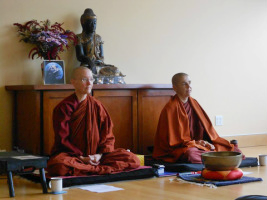
We women monastics don’t have the privilege of shutting ourselves off from the need for change. Because we are not part of the establishment, we live our lives on the front lines. As bhikkhunis, what pulls us to the front lines of climate change is the pioneering spirit of the bhikkhuni movement itself. We are already going against the grain to reestablish the order of fully ordained Theravada nuns; we’re willing to step out of a patriarchal system and create something new. And because we lack the “golden handcuffs” of abundant financial support, we don’t have to worry about keeping everybody happy. We have the freedom to respond to the urgent needs of the day, applying the Buddha’s teachings to the crises humanity faces now.

Image 1: Ayya Santussika and Ayya Santacitta 
teaching a daylong retreat on "Stable Heart, Stable 
Climate" at Insight Santa Cruz.
We are working to pass on to the next generation a presentation of the Dhamma that is applicable to this day and age. A contemporary Dhamma has to be embodied by both female and male monastics, otherwise many people will turn away, thinking this religion doesn’t recognize the clear truth that women and men alike are both sorely needed as leaders. The Dhamma must not be confined to the old order of things, which is very much about dominating nature, taking what you can get and throwing back what you don’t want. This is the way women—and the environment—have been treated for centuries. As bhikkhunis, we are stepping out of that.

Monday, June 1, 2015

History of Women in Buddhism - Indonesia: Part 9

Tomé Pires Witness & the Beguines, 

change comes to the roles of women in religion in Indonesia


Ayyā Tathālokā Bhikkhunī

In this ninth post in our “History of Women in Buddhism - Indonesia” series leading up to the Sakyadhita International Buddhist Women’s Conference in Indonesia, we come to the last of the ancient and premodern records of Buddhist women leaders, kilis and bhikkhunīs in Indonesian Buddhism, with one final and telling glimpse from a surprising Western source, before sweeping social changes overtook Java, Sumatra and much of the archipelago. We touch on some of the changes brought by Islam and by Colonialism, and the impact they had on women in Indonesian religion and spirituality, and women in Buddhism.

Extracted from Ayyā Tathālokā’s paper “Light of the Kilis: Our Indonesian Bhikkhuni Ancestors,” this article is part of the series leading up to the 14th Sakyadhita Conference in Yogyakarta, Indonesia. This article is dedicated to the first Theravada bhikkhunī ordination in contemporary times in Indonesia which is planned to precede the Sakyadhita Conference in June 2015. 


Monday, May 25, 2015

History of Women in Buddhism - Indonesia: Part 8

Gāyatrī Rājapatni: Queen, Bhikkhunī & the Prajñāpāramitā


Ayyā Tathālokā Bhikkhunī[1]

In this eighth post in our “History of Women in Buddhism - Indonesia” series leading up to the Sakyadhita International Buddhist Women’s Conference in Yogyakarta, Indonesia, we explore the life of one of Indonesia’s most interesting historical Buddhist women.  Earlier prominent women leaders and women ascetics/monastics/nuns that we’ve portrayed in this series such as Ken Dedes, Bhrikuti, Devi Kilisuci, Ratu Shima and Manimekhalai have been interesting in enigma--they are fascinating in that we catch such brief glimpses of their lives, leaving so much to be filled in by imagination, as we find in the many Indonesian, Indian and Tibetan legends, operas and ballets through which their lives are popularly remembered. In this post however, we have the benefit of a lengthy and highly-descriptive historical documentary poem written by a co-contemporary Buddhist monastic poet/biographer/documenteur passed down to us intact, and at least one very well-preserved mortuary portrait image, the Prajñāpāramitā.  Of further interest in addendum is the role that this image has come to play in the contemporary re-nascence of the Theravada Bhikkhunī Sangha on the other side of the world, in North America.

Extracted from Ayyā Tathālokā’s paper “Light of the Kilis: Our Indonesian Bhikkhuni Ancestors,” this article is part of the series leading up to the 14th Sakyadhita Conference in Yogyakarta, Indonesia.  This post coincides with the release of the first English-language edition of Earl Drake’s Gayatri Rajapatni: The Woman Behind the Glory of Majapahit by Areca Books.


Gāyatrī Rājapatni: Queen, Bhikkhunī & the Prajñāpāramitā


Image 1: Prajñāpāramitā image from East Java
at the National Museum of Indonesia, Jakarta
We will now meet one of the greatest of those women whose life has been passed down to us in memory, posthumously captured by the Buddhist monk poet of the court who knew and wrote of her with such reverence and appreciation.  This woman is the lady Gāyatrī, also known as the Rājapatni, in a way somewhat similar to and reminiscent of the lady Gotamī, also known as the Great Prajāpatī.[2]

Gāyatrī was a devout Buddhist, and the youngest daughter of the founder of Majapahit, the last of the great Indonesian royal dynasties, known as the Rajasa Dynasty.  She had three elder siblings, and together they were known as The Four Princesses of Singasari (Singosari).  The epics remember Gāyatrī as having been a keen student of literature, and political, social and religious matters. She possessed extraordinary beauty, charm, wisdom and intelligence.  And yet, in 1276 CE, at the tender age of sixteen, in a terrible repeat of what happened to Airlangga two hundred years earlier {in Post 5}, her world went mad. She witnessed the destruction of her home and kingdom and the murder of her father under the unsuspected attack of the Duke of Kederi.

Monday, May 18, 2015

The Wisdom of Emotions

Extract from a Dhamma talk by Ajahn Sundara

Our emotions can be triggered by something very small: a physical sensation, a passing thought, a sense contact, a feeling. In the context of Dhamma we begin to notice that in fact emotions are constructs: amalgams of thought, feeling, perceptions, past conditioning, trauma, family stories; all these things come together to generate emotions. Sometimes we are in a situation where for no apparent reason we start crying, or we become angry or confused. When we search for a reason but can’t find one, we may think there is something wrong with us, that it’s our fault. We make ourselves miserable because we don’t understand that there is a bigger picture. Being human is like that.

Modern psychology has not been able to define emotion. Decades of brain research have failed to pin down what an emotion is. It fluctuates constantly; it is indefinable. So we may be sitting calmly in meditation, surrounded by a lot of other people, but when somebody else comes into the room our sense of calm changes. We are aware of a new feeling tone, perhaps an emotional charge in the body and we soon realize that letting go of it requires more than just awareness and willingness to let go. It also calls for wisdom, for understanding, so as to see deeply its true characteristics of anicca-dukkha-anattā – that it is impermanent, unsatisfactory, and not-self.

Monday, May 11, 2015

“We must get back to the real roots of our Buddhist culture”

An interview with Ven. Bodhicitta by Raymond Lam

Ven. Bodhicitta
In March, Buddhistdoor International published an editorial about the era of simultaneous crisis and opportunity for the Theravada sangha across the traditional Buddhist world. The problems for the sangha, while always influenced by politics, social forces, and shifting economic dynamics, are largely internal: nationalism, sexism (and in some cases institutional gynophobia) and a lack of education form a triple-pronged threat to the Theravada sangha’s moral authority (and for some critics, outright relevance). Yet the other face of crisis is opportunity:  In both Asia and the West, watchers and commentators of Buddhism’s story in the globalizing world are noticing several hotspots where events may well reverberate across Asia and influence social justice movements positively.

Take, for example, the recent establishment of a Buddhist college for nuns in Sri Lanka. Regardless of the politics (and monks are always political in Sri Lanka), it is difficult to disagree that this is a millennial milestone for the country’s Buddhist community, and it is one example of turning the crisis of women’s lack of opportunity to practice into a chance to strengthen and reform the sangha – something that all Buddhists surely agree is a good thing.

One of the nuns bearing witness to these changes is Ven. Bodhicitta, founder of the Nisala Arana in Molkawa. Like many pro-bhikkhuni teachers across the world, Ven. Bodhicitta believes that traditional Buddhist values were never patriarchal, androcentric, misogynistic or sexist to begin with. She therefore does not accept the a priori fusion of the Buddhist story with the male experience, and like many feminists, seeks to entangle social conditioning from reality. “Most traditional societies have been conservative, but I don’t think this is the issue. The problem in places like Thailand is more to do with an overarching patriarchy,” she says. “Men are seen as leaders and promoted to positions of authority in patriarchal society, whereas women always have to take a second place, a subordinated place, in society.”

Monday, April 27, 2015

History of Women in Buddhism - Indonesia: Part 6

Bhrikutī & the Appearance of New Non-Bhikkhunī Forms of Women’s Asceticism in Buddhism


Ayyā Tathālokā Bhikkhunī

Image 1: Bhrikutī Devī, Nepal
In this sixth post in our “History of Women in Buddhism - Indonesia” series, we pick up a topic that is only hinted at being possible in Part 5 - the subject of the appearance of non-bhikkhunī/bhikṣuṇī forms of women’s (and men’s) ascetic/spiritual ideals (and practices) in Buddhism.  It is a time in history or her-story when both royal blood and ascetic spiritual power and mastery appear to have become an essential qualification of the deification of the fe/male rulers of the land, often united with or balanced by their co-appearance as either awesome likenesses or living embodiments of the bodhisattvas and buddhas of Mantranāya and Tantrayāna Buddhism, which has been spreading and developing in Java now for a period of more than 500 years (from the 7th-13th century). We look at one such example in the image of Bhrikutī, an apparently royal female ascetic of spiritual power, who appears very close to the most exemplary Śaivite royal female ascetic and consort, Parvatī, and yet is a manifestation of both the Buddhist wisdom of the bodhisattva Avalokiteśvara, and the fierce form of compassion of the savioress, Bhagavātī Aryā Tārā.
This post is specially dedicated to all those affected by the 25 April 2015 earthquakes in Nepal and the surrounding areas, to all those in need, and to all those who are helping. 
Extracted from Ayyā Tathālokā’s paper “Light of the Kilis: Our Indonesian Bhikkhunī Ancestors,” this is the sixth part in our “Women in Buddhism - Indonesia” mini-series leading up to the 14th Sakyadhita Conference in Borobudur, Indonesia.

Monday, April 20, 2015

History of Women in Buddhism - Indonesia: Part 5

The Mystery Story of Devi Kili Suci ~ the 11th Century Vanishing Crown Princess Bhikkhunī Hermit & Her Selomangleng Goa Cave


Ayyā Tathālokā Bhikkhunī

Image 1: Putrī Sanggramawijaya/
Devi Kili Suci
In this fifth post in our “History of Women in Buddhism - Indonesia” series, we skip over the Borobudur period ahead in time to the 11th century, to a time when royals’ renunciation of the throne for monastic life appears almost commonplace, and the Indonesian mountain hermitages and grottos are frequented by both male and female hermit ascetics of various faiths. Mantranāya/Vajrayāna Buddhism has been spreading in Java since at least the end of the seventh century and has grown strong. We explore the still-popular legendary story of one crown princess turned kili/wiksuni/bhikkhunī/mahāsiddhā, and visit the cave where she lived, practiced, and mysteriously vanished from corporeal existence.

Extracted from Ayyā Tathālokā’s paper “Light of the Kilis: Our Indonesian Bhikkhunī Ancestors,” this is the fifth part in our mini-series leading up to the 14th Sakyadhita Conference in Borobudur, Indonesia.

Monday, April 13, 2015

History of Women in Buddhism - Indonesia: Part 4

International Buddhist Networking, Bhikkhunīs and Women’s Leadership in the 5th-7th Century Indonesian South Seas 


Ayyā Tathālokā Bhikkhunī

This fourth post in our "History of Women in Buddhism" series examines the International Buddhist networks that became well established between India, Indonesia, Sri Lanka and China. 

This post specially coincides with Songkran/Saṃkrānti--the South and Southeast Asian Solar New Year in April, a time in which the sun appears to reach its zenith in the sky and maximum strength. We cover a time period when Buddhism rose in Indonesia, and International Buddhist networks and scholarship rose to a point of fluorescence. Powerful women leaders patronized Buddhist scholarship and the Bhikkhunī Sangha was widespread and well-established. 

Extracted from Ayyā Tathālokā’s paper “Light of the Kilis: Our Indonesian Bhikkhuni Ancestors,” it is the fourth part of the series leading up to the 14th Sakyadhita Conference in Borobudur, Indonesia. [Also: read about worthy historical places to visit, the ancient terminology, and the journey of an Indian nun ]

Monday, April 6, 2015

History of Women in Buddhism - Indonesia: Part 3

South Indian Bhikkhunī Manimekalai Travels to Java


Article author: Āyyā Tathālokā Bhikkhunī
Introduction to this segment: Tathālokā Bhikkhunī and Ādhimuttā Bhikkhunī 

Image 1: Manimekalai distributing food to the needy
with her magic bowl. In contemporary South Indian 
paintings, of which there are many as she continues 
to be a legendary folk hero, she is almost always 
depicted more in appearance like a modern Hindu 
sannyāsinī than a Buddhist monastic.
This third post in our "History of Women in Buddhism" series records the dramatic and inspiring life story of a Buddhist woman saint, Manimekalai, second century South India’s Buddhist Mother Theresa.[1] It examines marks of the status and the mobility of ancient South and Southeast Asian Buddhist women monastics, their environmental and social justice ethics, their rights of self-determination, relationship with politics, and how Buddhism was proactively compared with regards gender issues and women’s rights to other faiths, doctrines and religions of the period. 

This post especially coincides with the Sri Lankan Buddhist observance of Bak Poya on the full moon of April, the commemorative date of the Buddha’s visit to the Isle of Manipallavam aka Nagadipa, which figures so prominently in the life story of Manimekalai.  

Extracted from Ayyā Tathālokā’s paper “Light of the Kilis: Our Indonesian Bhikkhuni Ancestors,” it is part of the series leading up to the 14th Sakyadhita Conference in Borobudur, Indonesia. [Also: read the worthy historical places to visit and about the ancient terminology]

Monday, March 23, 2015

History of Women in Buddhism - Indonesia: Part 2

Indonesian Bhikkhuṇīs & Women Ascetics: A Historical Introduction & Survey of Terminology


Article by Tathālokā Bhikkhunī  
Intro by Ādhimuttā Bhikkhunī

This second part of History of Women in Buddhism series, leading up to the 14th Sakyadhita Conference in Borobudur, is an extract from Ayyā Tathālokā’s paper “Light of the Kilis: Our Indonesian Bhikkhuni Ancestors.” It provides an overview of the Indonesian terminology and a brief historical overview. It explores something of what is known of the ancient Buddhist women monastics and ascetics of the Indonesian archipelago through the travelogues, local oral traditions, dedicatory inscriptions, monuments and statuary that remains of them within their cultural and historical context."

Monday, February 9, 2015

History of Women in Buddhism - Indonesia: Introduction

Twelve Javanese Sites Worthy of Interest: Monuments & Sites Related to Women in Buddhism & Bhikkhunīs


Historical Site Article Extracts: Tathālokā Bhikkhunī, 
Maps: Ānandajoti Bhikkhu, 
Introduction: Ādhimuttā Bhikkhunī and all, 
Layout: Ānagarikā Michelle 

Buddhist monastics and lay community members from around the world are preparing to travel to Indonesia for the 14th Sakyadhita Conference at Yogyakarta. For those interested in Buddhist women's history and the history of the ancient Bhikkhuṇī/Bhikṣuṇī Sangha in Indonesia, we thought to make information available about some of the historical (and her-storical) sites worth visiting.

This will enrich the experience of Conference participants in Indonesia providing invaluable opportunities for both intellectual learning and onsite experiential learning, as well as give means for those who cannot travel to learn and grow in knowledge and benefit together from afar.

In the months leading up to the 14th Sakyadhita Conference in Borobudur in June, from March thru May, we plan to publish a series of blog posts extracted from Ayyā Tathālokā's "Light of the Kilis: Our Ancient Bhikkhuṇī Ancestors" paper, researched and prepared for the Sakyadhita-Borobudur Conference. These extract posts will provide more in-depth discussion of various aspects of the History of Women in Buddhism in Indonesia, many with relationship to the historical sites highlighted here. One final site, Borobudur and its vicinity, will be covered and presented upon during the Conference itself, as the Conference will visit the Borobudur monument. At the time of the Conference, we hope to offer a complete downloadable pdf guide to the history and art of the Indonesian Buddhist women's historical sites presented in this series.

The map and information here offer a brief introduction to a few of the places on Java that we thought would be of greatest interest to know about beforehand, and potentially have the chance to plan to visit.