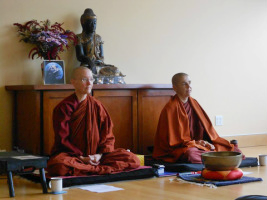
They came in robes and in street clothes, with perfectly coiffed hair and with shaved heads, in sandals, in boots, and in high heels. They came from all over the world, on wings, on wheels, by foot. They came, the Buddhists, the Muslims, the Hindus, and the Christians, and some who have set aside all religion. They came, over 1,000 of them, in search of inspiration. And that is what they found.
The 2015 Sakyadhita Conference is the first I have attended, though it has been offered for nearly 30 years now. Organized by an ordained woman who practices Tibetan Buddhism and teaches at the University of California in San Diego, the Venerable Karma Lekshe Tsomo, this conference for Buddhist women was centered on the theme of compassion and social justice. It is supported by Venerable Lekshe, other nuns and monks, and dozens of women and men volunteers who gain nothing but the satisfaction of knowing that they have helped so many.
Monday, July 13, 2015
Monday, June 29, 2015
History of Women in Buddhism - Indonesia: Part 10
Shedding Light on the Bhikkhunīs & the Great Founding Women of Borobudur
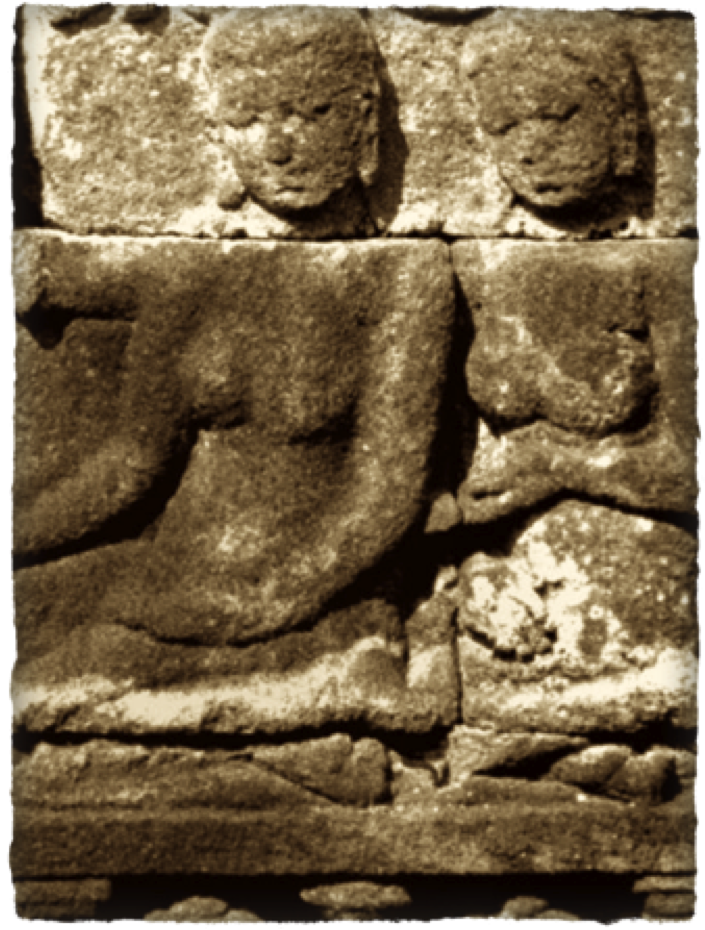
Ayyā Tathālokā Bhikkhunī| Image 1: Bhikkhunīs of Borobudur |
Chronologically, this post falls between part 4 and part 5 in this Awakening Buddhist Women blog series. Prepared especially for the 14th Sakyadhita International Conference in Yogyakarta, this previously unpublished extract was presented live at the Sakyadhita Conference.
“Light of the Kilis” is based on research materials gathered from travelogues, local oral traditions, dedicatory inscriptions, monuments, and statuary, or what remains of these within their cultural and historical context. The materials span a time period of more than 2000 years, from the 3rd century BCE up to modern times.
Here we focus on the 8th and 9th centuries and materials that are of direct relevance to the Sakyadhita Conference locale and of special interest and value to women in Buddhism. I touch on the feminine aspect of Indonesian candis, the appearance and role of both the esoteric Bhagavatī Aryā Tārā, the human queen Devī Tārā, and her daughter (or granddaughter) Śrī Sanjiwana Prāmodhavardhanī, the latter two Buddhist women being key persons involved with the foundation and establishment of the world-famous Borobudur monument. I also highlight images of bhikṣuṇīs and the dual sangha (bhikkhus and bhikkhunīs) that are portrayed on three levels of the wall reliefs of the Borobudur monument. These images are of outstanding historical value, because we can glean from them unparalleled visual knowledge of Buddhist women’s monastic way of life at the time they were created. I review and describe these images in the context of the Dharma teaching stories they illustrate – shining examples of women’s leadership and eminence in the Buddhist sangha, as they were conceived of and understood during this period.
Monday, June 22, 2015
Moms and Dads Wait -- A Lot
Jacqueline Kramer
As I sit in the waiting room while my granddaughter, Nai’a, has her weekly piano lesson, it occurs to me that all over the world, moms and dads wait. They wait on cold, wet benches during soccer practice, they wait at markets to procure ingredients for the evening meal, they wait in cars, they wait in lines, they wait on couches during lessons and doctors visits, and they wait outside on dusty roads. Waiting is a universal factor of being a parent and homemaker. It is a factor few discuss, except occasionally, and then only with contempt. Waiting can be mind numbing. We tend to see it as a waste of time, a waste of what could have been a real life. Because of these many hours spent waiting instead of utilizing our talents, writing our novel or moving up the ladder of success, parenting is often viewed as the bottom of the occupational food chain. Women, particularly Western women, may feel they are watching their lives slip away from them like sand through open fingers.
There is a Zen practice called shikantaza that has some features in common with waiting. Shikantaza translates as just sitting. Bonnie Myotai Treace describes shikantaza as, “The brightest pain, the dullest ride home on the subway: just mountains and rivers proclaiming the awakening way. Nothing excluded.” This is how shikantaza works: with eyes closed or open, wherever you find yourself, just sit. Don’t try to do anything. If a thought comes, watch the thought as it enters and exits. It doesn’t matter if the thought is pleasant or unpleasant, kind or cruel. Adding judgment to the thought takes us far away from the present moment. Thought is just an amorphous event passing through your field of awareness. If a sound arises, hear it until it fades, if a challenging feeling comes, feel it without turning away or distracting yourself. If a pleasant feeling comes, share the space with it without trying to make it last longer. Everything just happens within a field of consciousness that watches without our making any attempt to change, understand or judge the content. In other words, we just sit. We become a field in which things happen. There is no doing anything, no visualizing, no noting, no focusing, no trying to be more or less anything. All is welcome. We are like a tree or a boulder. This is an openhanded, openhearted, intimate way of being with life just as it is.
As I sit in the waiting room while my granddaughter, Nai’a, has her weekly piano lesson, it occurs to me that all over the world, moms and dads wait. They wait on cold, wet benches during soccer practice, they wait at markets to procure ingredients for the evening meal, they wait in cars, they wait in lines, they wait on couches during lessons and doctors visits, and they wait outside on dusty roads. Waiting is a universal factor of being a parent and homemaker. It is a factor few discuss, except occasionally, and then only with contempt. Waiting can be mind numbing. We tend to see it as a waste of time, a waste of what could have been a real life. Because of these many hours spent waiting instead of utilizing our talents, writing our novel or moving up the ladder of success, parenting is often viewed as the bottom of the occupational food chain. Women, particularly Western women, may feel they are watching their lives slip away from them like sand through open fingers.
There is a Zen practice called shikantaza that has some features in common with waiting. Shikantaza translates as just sitting. Bonnie Myotai Treace describes shikantaza as, “The brightest pain, the dullest ride home on the subway: just mountains and rivers proclaiming the awakening way. Nothing excluded.” This is how shikantaza works: with eyes closed or open, wherever you find yourself, just sit. Don’t try to do anything. If a thought comes, watch the thought as it enters and exits. It doesn’t matter if the thought is pleasant or unpleasant, kind or cruel. Adding judgment to the thought takes us far away from the present moment. Thought is just an amorphous event passing through your field of awareness. If a sound arises, hear it until it fades, if a challenging feeling comes, feel it without turning away or distracting yourself. If a pleasant feeling comes, share the space with it without trying to make it last longer. Everything just happens within a field of consciousness that watches without our making any attempt to change, understand or judge the content. In other words, we just sit. We become a field in which things happen. There is no doing anything, no visualizing, no noting, no focusing, no trying to be more or less anything. All is welcome. We are like a tree or a boulder. This is an openhanded, openhearted, intimate way of being with life just as it is.
Monday, June 15, 2015
What Would I Do for the Dharma? Thinking about Ryonen
Susan Moon
Ryonen was a woman Zen teacher in 17th century Japan. A story about her has been cooking inside of me ever since I read it some years ago.
As a young woman, Ryonen Genso was an attendant to the empress, and was known for her beauty and intelligence. When the empress died, she felt the impermanence of life, and she went in search of a Zen master with whom she could practice.
She traveled to the monastery of Master Hakuo Dotai, who refused her because of her beauty, saying her womanly appearance would cause problems for the monks in his monastery.
Afterward, she saw some women pressing fabric by a river, and she took up a hot iron and held it against her face, scarring herself. Then she wrote this poem on the back of a small mirror:
![]() |
| Image 1: Calligraphy by Ryonen Genso |
As a young woman, Ryonen Genso was an attendant to the empress, and was known for her beauty and intelligence. When the empress died, she felt the impermanence of life, and she went in search of a Zen master with whom she could practice.
She traveled to the monastery of Master Hakuo Dotai, who refused her because of her beauty, saying her womanly appearance would cause problems for the monks in his monastery.
Afterward, she saw some women pressing fabric by a river, and she took up a hot iron and held it against her face, scarring herself. Then she wrote this poem on the back of a small mirror:
To serve my Empress, I burned incense to perfume my exquisite clothes.She returned to Hakuo and gave him the poem. Hakuo immediately accepted her as a disciple. She became abbess of his temple when he died, and later founded her own temple. Before her death she wrote the following poem:
Now as a homeless mendicant I burn my face to enter a Zen temple.
The four seasons flow naturally like this.
Who is this now in the midst of these changes?
This is the sixty-sixth autumn I have seen.
The moon still lights my face.
Don’t ask me about the meaning of Zen teachings—
Just listen to what the pines and cedars say on a windless night.
Monday, June 8, 2015
On the Front Lines
This essay was drawn from an interview conducted by Dennis Crean, former managing editor of Inquiring Mind (1998-2011) and Martha Kay Nelson, also an editor of the Mind (2011-present).
From Inquiring Mind, Vol. 31, #2 (Spring 2015). © 2015 by Inquiring Mind. Used by permission.
Paper copies of the final issue of Inquiring Mind are available here only until 15 June 2015.
__
By Ayya Santacitta & Ayya Santussika
We women monastics don’t have the privilege of shutting ourselves off from the need for change. Because we are not part of the establishment, we live our lives on the front lines. As bhikkhunis, what pulls us to the front lines of climate change is the pioneering spirit of the bhikkhuni movement itself. We are already going against the grain to reestablish the order of fully ordained Theravada nuns; we’re willing to step out of a patriarchal system and create something new. And because we lack the “golden handcuffs” of abundant financial support, we don’t have to worry about keeping everybody happy. We have the freedom to respond to the urgent needs of the day, applying the Buddha’s teachings to the crises humanity faces now.
We are working to pass on to the next generation a presentation of the Dhamma that is applicable to this day and age. A contemporary Dhamma has to be embodied by both female and male monastics, otherwise many people will turn away, thinking this religion doesn’t recognize the clear truth that women and men alike are both sorely needed as leaders. The Dhamma must not be confined to the old order of things, which is very much about dominating nature, taking what you can get and throwing back what you don’t want. This is the way women—and the environment—have been treated for centuries. As bhikkhunis, we are stepping out of that.
From Inquiring Mind, Vol. 31, #2 (Spring 2015). © 2015 by Inquiring Mind. Used by permission.
Paper copies of the final issue of Inquiring Mind are available here only until 15 June 2015.
__
By Ayya Santacitta & Ayya Santussika
We women monastics don’t have the privilege of shutting ourselves off from the need for change. Because we are not part of the establishment, we live our lives on the front lines. As bhikkhunis, what pulls us to the front lines of climate change is the pioneering spirit of the bhikkhuni movement itself. We are already going against the grain to reestablish the order of fully ordained Theravada nuns; we’re willing to step out of a patriarchal system and create something new. And because we lack the “golden handcuffs” of abundant financial support, we don’t have to worry about keeping everybody happy. We have the freedom to respond to the urgent needs of the day, applying the Buddha’s teachings to the crises humanity faces now.
![]() |
| Image 1: Ayya Santussika and Ayya Santacitta teaching a daylong retreat on "Stable Heart, Stable Climate" at Insight Santa Cruz. |
Monday, June 1, 2015
History of Women in Buddhism - Indonesia: Part 9
Tomé Pires Witness & the Beguines,
change comes to the roles of women in religion in Indonesia
Ayyā Tathālokā Bhikkhunī
In this ninth post in our “History of Women in Buddhism - Indonesia” series leading up to the Sakyadhita International Buddhist Women’s Conference in Indonesia, we come to the last of the ancient and premodern records of Buddhist women leaders, kilis and bhikkhunīs in Indonesian Buddhism, with one final and telling glimpse from a surprising Western source, before sweeping social changes overtook Java, Sumatra and much of the archipelago. We touch on some of the changes brought by Islam and by Colonialism, and the impact they had on women in Indonesian religion and spirituality, and women in Buddhism.
Extracted from Ayyā Tathālokā’s paper “Light of the Kilis: Our Indonesian Bhikkhuni Ancestors,” this article is part of the series leading up to the 14th Sakyadhita Conference in Yogyakarta, Indonesia. This article is dedicated to the first Theravada bhikkhunī ordination in contemporary times in Indonesia which is planned to precede the Sakyadhita Conference in June 2015.
Monday, May 25, 2015
History of Women in Buddhism - Indonesia: Part 8
Gāyatrī Rājapatni: Queen, Bhikkhunī & the Prajñāpāramitā
Ayyā Tathālokā Bhikkhunī[1]
In this eighth post in our “History of Women in Buddhism - Indonesia” series leading up to the Sakyadhita International Buddhist Women’s Conference in Yogyakarta, Indonesia, we explore the life of one of Indonesia’s most interesting historical Buddhist women. Earlier prominent women leaders and women ascetics/monastics/nuns that we’ve portrayed in this series such as Ken Dedes, Bhrikuti, Devi Kilisuci, Ratu Shima and Manimekhalai have been interesting in enigma--they are fascinating in that we catch such brief glimpses of their lives, leaving so much to be filled in by imagination, as we find in the many Indonesian, Indian and Tibetan legends, operas and ballets through which their lives are popularly remembered. In this post however, we have the benefit of a lengthy and highly-descriptive historical documentary poem written by a co-contemporary Buddhist monastic poet/biographer/documenteur passed down to us intact, and at least one very well-preserved mortuary portrait image, the Prajñāpāramitā. Of further interest in addendum is the role that this image has come to play in the contemporary re-nascence of the Theravada Bhikkhunī Sangha on the other side of the world, in North America.
Extracted from Ayyā Tathālokā’s paper “Light of the Kilis: Our Indonesian Bhikkhuni Ancestors,” this article is part of the series leading up to the 14th Sakyadhita Conference in Yogyakarta, Indonesia. This post coincides with the release of the first English-language edition of Earl Drake’s Gayatri Rajapatni: The Woman Behind the Glory of Majapahit by Areca Books.
Gāyatrī Rājapatni: Queen, Bhikkhunī & the Prajñāpāramitā
![]() |
| Image 1: Prajñāpāramitā image from East Java at the National Museum of Indonesia, Jakarta |
Gāyatrī was a devout Buddhist, and the youngest daughter of the founder of Majapahit, the last of the great Indonesian royal dynasties, known as the Rajasa Dynasty. She had three elder siblings, and together they were known as The Four Princesses of Singasari (Singosari). The epics remember Gāyatrī as having been a keen student of literature, and political, social and religious matters. She possessed extraordinary beauty, charm, wisdom and intelligence. And yet, in 1276 CE, at the tender age of sixteen, in a terrible repeat of what happened to Airlangga two hundred years earlier {in Post 5}, her world went mad. She witnessed the destruction of her home and kingdom and the murder of her father under the unsuspected attack of the Duke of Kederi.
Labels:
Ayya Tathaaloka,
Ayyā Tathālokā,
Bhikkhunis,
Bhiksunis,
Buddhist Queens,
Gender in Buddhism,
History of Women in Buddhism,
Human Interest,
Sakyadhita,
Sakyadhita Conferences,
Women in Buddhism
Subscribe to:
Posts (Atom)